
Article: How to Use a Tongue Scraper Properly: Benefits, Technique & Mistakes to Avoid
How to Use a Tongue Scraper Properly: Benefits, Technique & Mistakes to Avoid
The 30-second oral beauty step your routine may be missing.
Most people brush. Some floss. Far fewer clean their tongue and yet the tongue is one of the largest surfaces in the mouth, and one of the most significant sources of bad breath, bacteria build-up and that unpleasant coated feeling that no amount of brushing quite fixes.
Tongue scraping is simple, takes less than a minute and makes a noticeable difference. Here's everything you need to know.
What is a tongue scraper?
A tongue scraper is a small, curved tool designed to glide across the surface of the tongue and remove the thin coating of bacteria, dead cells, food debris and mucus that accumulates there overnight and throughout the day.
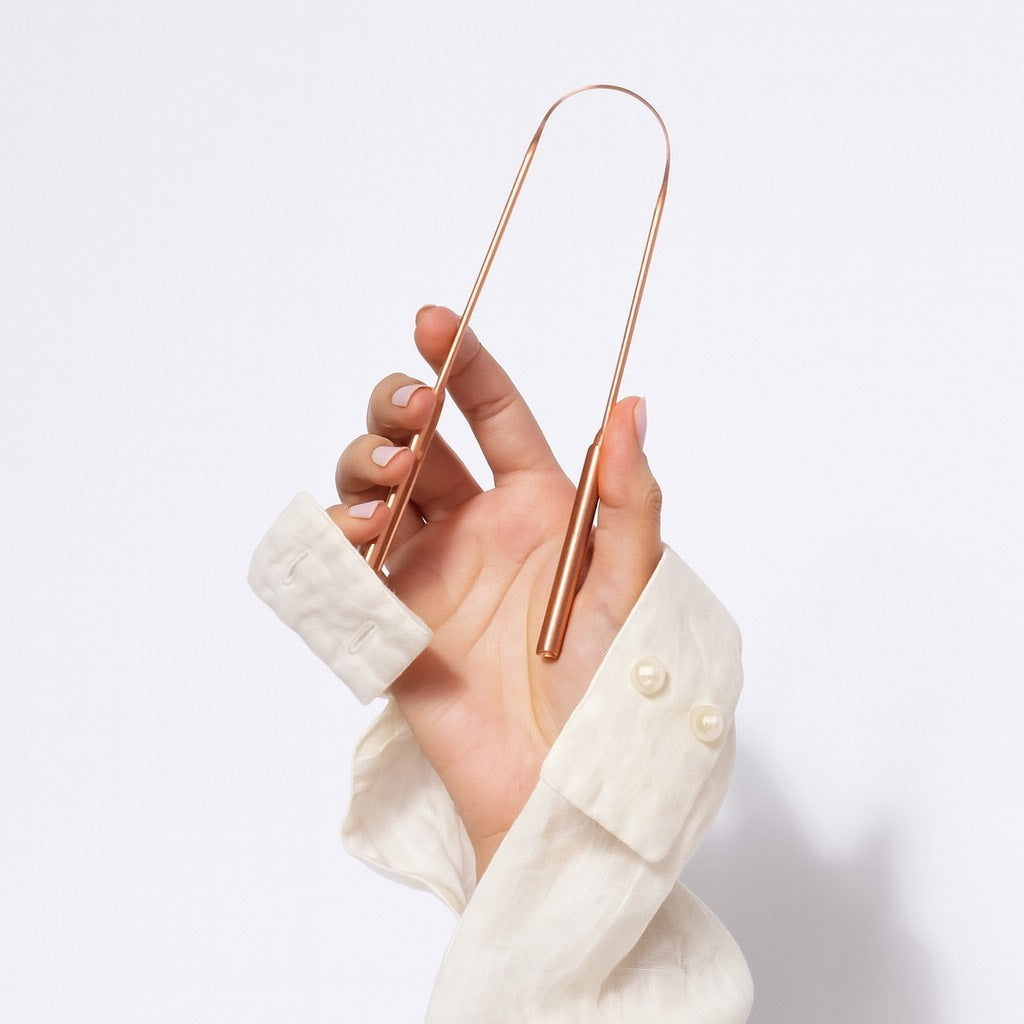
They come in various materials plastic, stainless steel and copper, each with slightly different properties. Our Copper Tongue Scraper is made from pure copper, which is naturally antimicrobial, long-lasting and plastic-free. It's designed to be part of your routine for years, not weeks.
Why should you clean your tongue?
Your tongue's surface is covered in tiny papillae small bumps that create a textured surface ideal for trapping bacteria and debris. That build-up contributes to:
- Bad breath - the bacteria on your tongue produce volatile sulphur compounds, the primary cause of unpleasant breath.
- A coated or white tongue - a visible layer of bacteria, dead cells and food particles.
- Reduced taste sensation - build-up on the tongue can dull your ability to taste food properly.
- An incomplete oral routine - brushing and flossing clean the teeth and gums, but leave the tongue largely untouched.
Tongue scraping isn't a replacement for brushing, flossing or seeing your dentist regularly. It's a complementary step that addresses a part of the mouth that most oral care routines overlook.
How to use a tongue scraper: step by step
- Start at the back. Open your mouth and extend your tongue. Place the scraper as far back on your tongue as is comfortable don't force it.
- Apply gentle pressure. Using light, even pressure never harsh or forceful drag the scraper forward towards the tip of the tongue in one smooth motion.
- Rinse the scraper. Rinse the scraper under running water to remove debris between strokes.
- Repeat. Repeat 4-5 times, working across the full width of the tongue.
- Rinse your mouth. Rinse your mouth with water once you've finished.
- Clean your scraper. Rinse the scraper thoroughly and allow it to air dry.
Important: use gentle pressure only. Pressing too hard can irritate or scratch the surface of the tongue. If you feel any discomfort, ease off.
When and how often should you scrape your tongue?
Once a day is ideal for most people in the morning, before or after brushing. The overnight period is when bacterial build-up is at its peak, so morning scraping delivers the most noticeable result.
Some people choose to scrape morning and evening. This is fine as long as you're using gentle pressure. There's no benefit to scraping more frequently than this.
Common tongue-scraping mistakes
- Pressing too hard. The tongue's surface is sensitive. Gentle, consistent strokes are more effective and safer than aggressive scraping.
- Not going far enough back. Most bacteria accumulate towards the back of the tongue. Start as far back as is comfortable.
- Skipping the rinse. Always rinse the scraper between strokes to avoid redepositing debris back onto the tongue.
- Using it instead of brushing. Tongue scraping complements brushing and flossing it doesn't replace either.
- Forgetting to clean the scraper. Rinse and dry your scraper after every use. For copper scrapers, an occasional wipe with a clean cloth keeps the surface in good condition.
Tongue scraper or toothbrush: which works better?
Research consistently shows that tongue scrapers are more effective than toothbrushes for reducing tongue coating and the bacteria that cause bad breath. A toothbrush can help, but its bristles tend to move debris around rather than removing it cleanly from the surface.
For the best results, use both: brush your teeth thoroughly, then finish with a tongue scraper for a genuinely clean-feeling mouth.
How tongue scraping fits into an oral-beauty routine
At Polished London, we think about oral care the same way we think about skincare as a ritual worth doing properly, with ingredients and tools that genuinely work.
Tongue scraping fits naturally into that approach. It's 30 seconds. It's effective. And it completes the mouth-cleaning routine in a way that brushing alone simply can't.
Pair it with:
- Cloudberry + Mint Prebiotic Toothpaste - to support your oral microbiome and gently brighten with every brush.
- Vanilla Dental Floss - to clean between teeth and support healthier gums.
- Copper Tongue Scraper - your 30-second daily reset for a cleaner, fresher mouth.
Together, these three steps brush, floss, scrape cover every surface of the mouth. Read more about supporting your oral microbiome in our guide: How to Nurture Your Microbiome and Your Mouth Has a Microbiome Too.
When bad breath needs professional advice
Tongue scraping can significantly reduce bad breath caused by everyday bacterial build-up. But persistent bad breath, a heavily coated tongue, mouth sores or tongue pain that doesn't resolve with good oral hygiene should always be discussed with your dentist or GP. These can occasionally be signs of an underlying condition that needs professional attention.
FAQs
Should you scrape before or after brushing?
Either works. Many people prefer to scrape first to remove the overnight coating, then brush. Others scrape after brushing as a final step. Consistency matters more than order.
Can you use a tongue scraper every day?
Yes — daily use is recommended for most people. Once a day (morning) is the most common and effective routine.
How many times should you scrape?
5–7 strokes, covering the full width of the tongue, is sufficient for most people.
Can you scrape too hard?
Yes. Too much pressure can irritate or scratch the tongue's surface. Always use gentle, even pressure and stop if you experience any discomfort.
Does tongue scraping help bad breath?
Yes. Studies show tongue scraping is one of the most effective at-home methods for reducing the bacteria responsible for bad breath. It works best as part of a complete oral care routine.
Why is the tongue white?
A white or coated tongue is caused by a build-up of bacteria, dead cells, food debris and mucus on the tongue's surface. It's normal, especially in the morning, and is exactly what tongue scraping removes. Persistent white patches that don't resolve should be checked by a dentist or GP.
How should you clean a copper tongue scraper?
Rinse thoroughly under running water after each use and allow to air dry. Copper is naturally antimicrobial, so it doesn't require harsh cleaning products. An occasional gentle wipe with a clean cloth keeps it in good condition. Copper may develop a natural patina over time — this is normal and doesn't affect performance.
How often should a tongue scraper be replaced?
A well-maintained copper tongue scraper can last for years. Unlike plastic scrapers, copper is durable and doesn't degrade with regular use. Replace it if it becomes damaged or bent.
—
Complete your SmileCare routine:
- Copper Tongue Detox Scraper — naturally antimicrobial, plastic-free, built to last.
- Cloudberry + Mint Prebiotic Toothpaste — support your oral microbiome with every brush.
- Vanilla Dental Floss — clean between teeth daily for healthier gums.
- Coconut Dental Floss — a naturally fragranced alternative.
- Sonic XP Electric Toothbrush — 40,000 strokes per minute for a dentist-clean feel.
Blog posts
How to Use a Tongue Scraper Properly: Benefits, Technique & Mistakes to Avoid
The 30-second oral beauty step your routine may be missing. Most people brush. Some floss. Far fewer clean their tongue and yet the tongue is one of the largest surfaces in the mouth, and one of th...
Read more
Is Teeth Whitening Safe for Sensitive Teeth?
If you've ever wanted a brighter smile but held back because of sensitivity, you're not alone. Sensitivity is the number one reason people avoid teeth whitening and for years, that hesitation made ...
Read more
Your Mouth Has a Microbiome Too.
You cleanse your skin. You hydrate it. You choose ingredients that support its natural balance. But what about your mouth? Just like your skin, your mouth has its own microbiome: a community of mic...
Read more